 Gable Roofed
 School Classroom
 Golf Room
 Snooker Room
 Home Office
 Home Gym
 Garden Annex
 Garden Studio
 Cinema Room
 Cocktail Bar
 Indoor Pool
 Beautician's Studio
 Café Area

Are garden studios soundproof
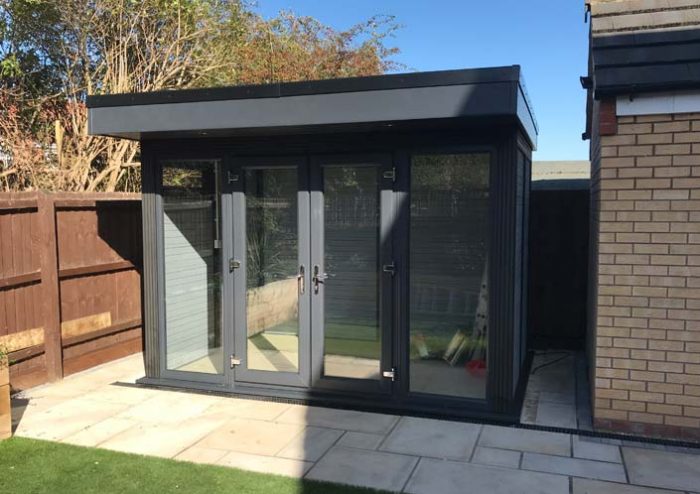
So, Are garden studios soundproof
No garden studio is completely soundproof, but a well-built one cuts sound dramatically in both directions, and how quiet you can realistically make it depends on what you are trying to keep in or out. Total soundproofing, meaning no sound passes at all, is a specialist and expensive build that very few garden studios actually need. What a properly insulated composite studio gives you is a sealed, solid room that reduces everyday noise enough for the vast majority of uses, and a strong base to build on if you need more.
The useful way to think about it is by activity rather than by the word soundproof. A studio for taking calls, writing, painting or quiet hobbies needs almost nothing beyond the standard insulated build. A studio for amplified music, a drum kit or serious recording needs deliberate acoustic upgrades designed in from the start. Most people sit somewhere between the two. So rather than asking whether a garden studio is soundproof, the better question is how quiet does it need to be for what I will actually do in it, and the rest of this answers exactly that.
How quiet you need it to be
It helps to be concrete about realistic targets. A home office or art studio just needs to feel calm, with street noise and household sound pushed into the background. The standard build handles that comfortably, and most people are surprised how much quieter it is than the house.
A practice space for an acoustic instrument, singing or quiet recording sits a step up. Here you want the room to contain enough sound that you are not bothering anyone, and to keep enough out that recordings stay clean, which usually means upgraded glazing and some internal treatment. A drum kit, amplified band or professional studio is the demanding end, and that genuinely needs a heavier soundproofing package built into the design. Matching the spec to the activity is the whole exercise, and the most expensive mistake we see is people specifying a recording-grade build for a room they only ever take video calls in.
Keeping sound in is not the same as keeping it out
These are two different problems and they call for slightly different solutions, which is why generic soundproofing advice so often disappoints. Keeping noise out, for an office or studio near a busy road, is mostly about sealing the building and improving the glazing, because external noise is usually airborne and finds its way through gaps and thin glass.
Keeping noise in, for music, means stopping sound energy passing through the structure as well as the air, which takes mass and decoupling, not just sealing. From working with clients across Enfield, we have found that confusing the two is the root of most disappointment, because someone wanting to play drums buys thicker glazing aimed at keeping traffic out and is then surprised the kit is still audible three gardens away. Knowing which direction your problem runs decides where the money should go.
Where the sound actually leaks
Whichever direction you are working in, the weak points are almost always the openings, not the panels. Sound behaves like water and finds the smallest gap, so an unsealed edge around a door will undo a great deal of expensive wall work. The practical priorities for a quieter studio are therefore tight seals around every opening, solid well-fitted doors, and good glazing, in that order.
On our rooms the double-glazed windows and secure doors seal the openings properly, which is the single biggest factor in how a finished studio performs. A draughty gap under a cheap door is the difference between a room that feels genuinely quiet and one that never quite does, regardless of how good the structure around it is.
What the standard composite build already gives you
A composite studio starts from a strong position because it is built as a properly insulated, sealed shell rather than a single-skin shed. The insulated walls and high-performance insulated roof add the mass and absorption that reduce sound transfer, while the sealed openings stop the easy leaks.
There is also an advantage people rarely consider. Because our studios sit on a level, no-dig base rather than being tied into a slab connected to the house, there is less structure-borne vibration travelling between the studio and the main building. The most reliable way to judge any of this is with your own ears, so when you visit the showroom at 150 Chase Side, close the door and listen to how far the outside noise drops. That tells you more than any specification sheet.
Acoustic treatment is a different job again
One distinction trips almost everyone up. Stopping sound escaping the building and making the room sound good inside are two separate things. Acoustic foam and panels control echo and reverberation within the room, which matters for recording and music, but they do very little to stop sound leaving the building.
In our experience, a decoupled inner layer works better than sticking acoustic foam to the walls when the goal is containment, because foam tidies up the sound inside the room but barely touches what your neighbours hear. If you want a studio that both sounds clean and stays quiet to the outside world, you need the structural side for containment and the treatment side for internal acoustics, and it is far better to plan both at the design stage. Because most of our work is bespoke, the studio can be sized and specified around how loud you actually intend to be, rather than retrofitting a finished room and losing internal space in the process.
Being a good neighbour in Enfield
Gardens across Enfield tend to sit close together, so even a well-built studio benefits from sensible placement, with a little distance from the boundary and the noisier end of the room turned away from neighbouring houses. No amount of building fabric replaces basic consideration, so if you plan regular amplified music it is worth keeping to reasonable hours. Persistent noise can fall under statutory nuisance rules enforced by the council, and the government’s guidance on noise complaints is a useful reference for understanding where the lines sit. A studio that is built well and used considerately keeps the peace in both directions, which is usually the real aim.
Talk through what you actually need
The honest way to specify a studio is to start from how you will use it, then build only the soundproofing that use calls for. We would always rather match the room to the activity than sell you a package you do not need, so tell us what you have in mind and we will recommend the right level.
You are welcome to visit the showroom at 150 Chase Side, Enfield EN2 0QX, or get in touch to arrange a visit and stand in one. Call us on 07816 898512, or request a callback at a time that suits you.
You can also see finished builds and behind-the-scenes installations on our Facebook page and our YouTube channel.