 Gable Roofed
 School Classroom
 Golf Room
 Snooker Room
 Home Office
 Home Gym
 Garden Annex
 Garden Studio
 Cinema Room
 Cocktail Bar
 Indoor Pool
 Beautician's Studio
 Café Area

How to choose a woodgrain colour for you Garden Room
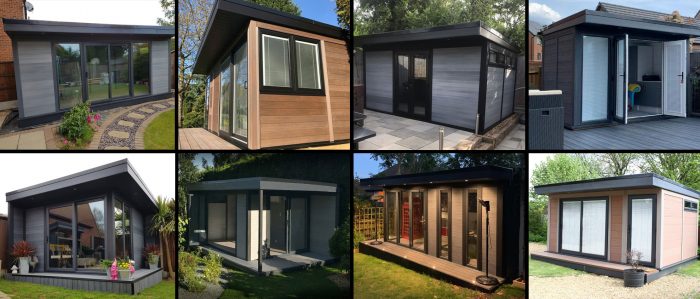
What is the Best Way of Choosing a Woodgrain Colour for Your Garden Room
Choosing a woodgrain colour for your garden room really comes down to one decision: do you want the building to blend quietly into the garden, or stand out as a feature? Everything else follows from that. Our composite cladding comes in a range of natural woodgrain shades, from pale, contemporary greys through warm natural timber tones to deep, dramatic darks, and each can be specified as a single colour throughout or as a dual finish that combines two. There is no wrong answer, only what suits your house, your garden and the look you are after.
The practical way to approach it is to think about three things together: the colour of your house and any existing garden structures, how much light the spot gets, and whether you want the room to recede or draw the eye. A composite garden room is a permanent, year-round building you will look at every day, so the colour matters more than with a temporary structure. The good news is that because the colour is built into the timber-effect composite rather than painted on, whatever you choose holds its look for years. Below is how to narrow it down.
The shades available
Our woodgrain colour range spans the tones most people want for a garden building, and it helps to think of them in three groups. The lighter shades, such as Oyster Grey and Light Grey, give a soft, contemporary feel that keeps the building looking fresh and unobtrusive. The natural wood tones, like Walnut, lean into the authentic timber look, with rich, warm grain that reads as real wood from across the garden. The darker shades, including Dark Grey, give a bold, modern, architectural finish that makes the room a deliberate statement.
Every option carries genuine woodgrain texture, so even the greys look like timber rather than flat, painted board. Seeing them grouped this way usually makes the shortlist obvious, because most people know quite quickly whether they are drawn to light and airy, warm and natural, or dark and striking.
Blend in or stand out
This is the decision that shapes everything else. If you want the room to sit quietly and let the garden be the star, a mid to light natural tone or a soft grey tends to disappear into planting and fencing beautifully, especially once shrubs grow up around it. If you want the building to be a feature in its own right, a darker grey creates strong contrast against green planting and looks particularly smart on a more contemporary house.
From working with clients across Enfield, we have found the choice often tracks the age and style of the house. Period and traditional homes usually suit the warmer natural wood tones, which feel established and soft, while newer or more modern properties tend to carry the darker greys well. Matching the room to the character of the house, rather than choosing a colour in isolation, is what makes the finished building look like it belongs.
Single or dual colour
You are not limited to one shade. A dual colour finish combines two tones on the same building, most often a main body colour with a contrasting colour on the frames, doors or a feature section. It is a simple way to add depth and a more designed, bespoke look without any extra maintenance.
In our experience, a dual colour finish works better than a single colour for a building you want to stand out, because the contrast frames the doors and windows and gives the room a considered, architectural feel rather than a single flat block of colour. For a room you want to recede into the garden, a single natural tone is usually the calmer, better choice. So the single-or-dual decision follows directly from the blend-or-stand-out one, which is why it helps to settle that first.
How light and position change the look
Colour never looks the same on a swatch as it does on a full building in your garden, and light is the reason. A shade that looks mid-grey on a small sample can read much lighter in a bright, open, south-facing spot, and noticeably darker in a shaded corner overhung by trees or fences. Darker colours in particular can feel heavier in an enclosed, shady position and stunning in an open one.
This is worth bearing in mind on the more enclosed plots common across Enfield, where a garden room often sits in a corner that gets partial shade. In our experience, viewing a physical sample in the actual spot works better than choosing from a screen or a brochure, because on-screen colours shift with your monitor and the garden’s own light completely changes how a shade reads once it is up. It is a five-minute check that saves any second-guessing later.
Colour that lasts
One of the quiet advantages of composite is that the colour you choose is the colour you keep. Because the shade runs through the co-extruded material with no painting or staining, it will not flake, peel or need re-coating, and the tough outer skin resists fading far better than a stained timber finish exposed to the weather.
That changes how you should think about the choice. With a painted timber building, a bold colour is a commitment to repainting for years to come. With composite, you can choose a darker or more distinctive shade knowing it will look the same in a decade with nothing more than the occasional wash. It makes being a little braver with colour a much safer decision.
See the colours in person
The single best thing you can do before choosing is to see and handle the actual samples, ideally against your house and in the spot the room will go. You are welcome to visit the showroom at 150 Chase Side, Enfield EN2 0QX, where you can see the finishes on full buildings, or get in touch to arrange a visit. Call us on 07816 898512, or request a callback at a time that suits you.
You can also see finished builds in a range of colours on our Facebook page and our YouTube channel.